
Suka - Live Stream, Chat
M YasinLifestyle
0.00.00 Reviews
- Version
- 1.1.4
- Installs
- 100.00K
- Age Rating
- Mature 17+
Screenshots
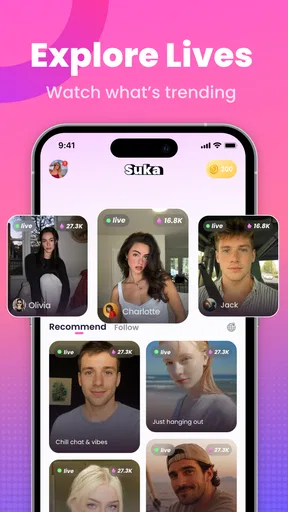
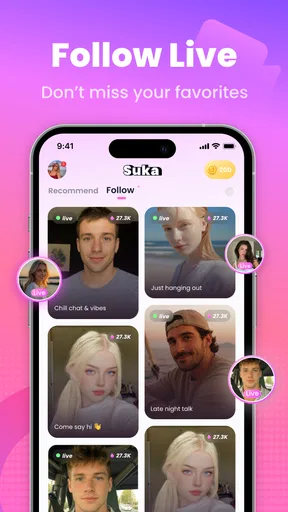

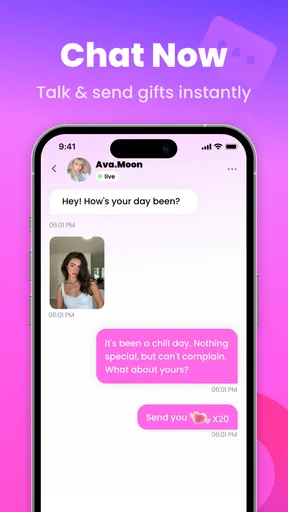
Our Review of Suka - Live Stream, Chat
 Analysis by Appyee
I spent time with Suka - Live Stream, Chat as a lifestyle app built around live interaction, and my first impression is that its appeal depends less on polished utility and more on the feeling of being present with other people. The central idea is simple: open the app, find real-time shows, and take part in conversations that are happening now rather than scrolling through content that was recorded earlier.
That makes Suka interesting for people who enjoy casual social discovery. It is not trying to replace a calendar, a messaging utility, or a traditional video platform in my view. Its purpose is closer to dropping into a lively room, watching a host or creator, and deciding whether the atmosphere is worth staying for. The experience can feel immediate and personal, but it also asks you to accept the unpredictability that comes with live content.
The app is developed by M Yasin and is available as a free download. It is listed for mature users aged 17 and above, so I would not treat it as a general family social app. That age guidance matters here: anyone considering it should be comfortable with an adult-oriented social environment and should use sensible judgment when interacting with people they do not know.
How Suka works in everyday use
The most useful way to understand Suka is to think of it as a live social window rather than a library of finished videos. A normal session might begin with curiosity: I open it with a few spare minutes, look through the live activity, and choose a show that seems interesting. If the host keeps the conversation moving, I can stay and participate; if the room feels quiet or unsuitable, I can leave without having invested much time.
This format suits short, unplanned sessions particularly well. For example, after work I might have ten minutes before preparing dinner. A conventional streaming service would make me choose something long enough to justify starting, while a messaging app would require me to find someone who is available. Suka offers a different option: I can check what is happening right now, watch for a while, and leave when my time is up.
That convenience is also the source of one of the app’s main weaknesses. Live platforms are shaped by who happens to be active at the moment. The quality of one visit may be very different from the next, and a promising title or preview does not guarantee an engaging conversation. I would approach Suka with the right expectation: it is a place for spontaneous interaction, not a dependable schedule of carefully edited entertainment.
The short store description is simply “Suka,” while its broader summary focuses on joining real-time shows and making connections. Those two lines do not explain the experience in detail, so new users should expect to learn the app through exploration. I found that this can be part of the appeal, but it can also make the first session feel less directed than using a familiar video or chat service.
Free access and where spending enters the picture
Suka can be installed without an upfront charge, which makes trying it relatively easy. The important distinction is that free installation does not mean every part of the experience has the same cost. The app includes in-app purchases ranging from $0.99 to $99.99 per item. I would therefore treat the free version as a way to inspect the community and understand the live format before deciding whether any paid element is worthwhile.
That pricing range is broad enough that users should slow down before confirming a purchase. A small occasional payment and a much larger item represent very different decisions, especially in a live social setting where excitement can build quickly. I would avoid buying anything simply because a host or conversation creates pressure in the moment. The safest approach is to decide in advance what, if anything, I am willing to spend and keep that limit separate from the entertainment itself.
The practical value of Suka is strongest when the free experience already gives me a reason to return. If I enjoy browsing live shows, meeting people casually, and participating without paying, the app can remain useful as a no-cost social pastime. If the parts I care about are tied to purchases, the value becomes more personal and harder to judge in advance. I would not assume that spending automatically creates better conversations or more meaningful connections.
For that reason, I see the paid side as optional rather than essential to my recommendation. The app’s basic proposition is live access and social contact; the purchase range means users need to evaluate any added value carefully. Someone who wants a completely predictable free service may prefer an alternative where the main experience is clearly available without purchase decisions appearing during interaction.
What value the live format delivers
The strongest benefit is immediacy. Recorded videos can be entertaining, but they do not offer the same possibility of being noticed or answered in the moment. Suka’s live focus gives the user a chance to feel involved rather than merely entertained. Even when I am mostly watching, the knowledge that the room is active changes the mood of the session.
There is also a useful low-commitment quality. I do not need to arrange a meeting, wait for a reply, or prepare a polished message before joining a conversation. That can be valuable for someone who wants social contact but is not looking for a formal group or a long-term community. It may also suit users who enjoy discovering different personalities instead of following one fixed creator or topic.
A less obvious strength is that the app can work as a test of social energy. On a quiet evening, I can join a live space and see whether I actually want conversation. If I am tired, I can simply observe or leave. This is different from direct messaging, where starting a conversation can feel like a commitment and ending it can feel awkward.
However, the same flexibility means Suka may not deliver a strong result every time. The app cannot guarantee that a live room will match my interests, that the host will respond, or that another participant will share my expectations. I would measure its value over several visits rather than judging it from one unusually good or disappointing session.
Small habits that make the experience better
My first practical tip is to use short sessions at the beginning. Instead of opening the app with the expectation of finding a new social circle immediately, I would spend a few minutes observing how different live spaces feel. This helps separate genuine interest from the excitement of seeing activity on screen.
Second, I would decide what kind of interaction I want before joining. There is a meaningful difference between quietly watching, chatting casually, and trying to build an ongoing connection. Entering a live show without knowing which of those I want can make an ordinary session feel disappointing. A clear personal goal makes it easier to leave when the room is not suitable.
Third, I would keep personal details limited until trust develops outside the initial live encounter. Real-time conversation can create a sense of familiarity faster than it deserves. I would avoid sharing private contact information, financial details, or identifying information simply because someone seems friendly. The mature age rating is not a substitute for personal safety, and the live format rewards a cautious approach.
Finally, I would treat purchases as a separate decision from social approval. If I enjoy a show, that does not mean I need to pay to prove appreciation or maintain the interaction. Waiting until after the session to consider whether an item has genuine value is a simple way to reduce impulse spending.
Where it differs from ordinary alternatives
Compared with a conventional video platform, Suka is less useful when I want reliable, searchable entertainment. A standard service is usually better for choosing a specific subject, watching at my own pace, and returning to a favorite recording. Suka is more appealing when the attraction is the people who are present now and the possibility of spontaneous exchange.
Compared with a normal messaging app, Suka lowers the barrier to finding an active social setting. I do not have to begin with an existing contact list or wait for a friend to answer. The compromise is that a live room can be less private and less predictable than a one-to-one conversation. Users who value control over who can contact them may feel more comfortable with direct messaging.
Compared with a structured social network, Suka appears more focused on the live moment than on maintaining a carefully organized profile or feed. That can feel refreshing if I dislike endless scrolling, but it may be frustrating if I want detailed context before deciding whom to follow or trust. The app is best understood as an encounter-based service, not a complete replacement for every other social tool.
This comparison also explains who should skip it. I would not recommend Suka to someone seeking children’s entertainment, a quiet private journal, a guaranteed educational program, or a fully controlled communication environment. I would also hesitate to recommend it to anyone who finds live social uncertainty stressful or who tends to make unplanned digital purchases.
Compatibility and the practical setup
The current version is 1.1.4, and the app supports devices running Android 7.0 or later. That gives it a fairly broad compatibility range for Android users, although the quality of any live experience will still depend on the individual device and connection. I would make sure the phone is updated enough to install the app and leave some time for a first-session check rather than opening it just before an important appointment.
Because Suka revolves around live shows and chat, the experience is naturally more dependent on being connected than an offline lifestyle tool. I would use it when I have a stable connection and enough privacy to decide whether I want to participate. A crowded commute or a weak signal may turn a potentially enjoyable session into a frustrating one, especially if the appeal depends on following a conversation as it happens.
The app’s mature rating should also shape where and when I use it. I would not hand the phone to a younger family member assuming that a free lifestyle download is automatically suitable for everyone. Parents and guardians should treat the age label seriously and use device-level controls where appropriate.
Who is most likely to get value?
Suka makes the most sense for adults who enjoy meeting people casually, browsing live activity without a fixed plan, and deciding for themselves how deeply to participate. It may be a good fit for someone who has a few spare moments and prefers human interaction over passive scrolling. It can also appeal to users who like discovering unfamiliar hosts or conversations rather than repeatedly watching the same established content.
I think it is particularly suitable for people who can handle uneven sessions. One visit may feel lively, while another may offer little reason to stay. If I accept that variation as part of the format, the app feels more relaxed. If I expect every opening to produce a valuable connection, I am likely to judge it too harshly.
Users who are careful with money can still try it, but I would recommend keeping the free experience as the baseline. The presence of purchases from $0.99 to $99.99 per item means the app should not be treated as cost-free simply because downloading it costs nothing. The right question is whether the unpaid experience is already enjoyable enough, not whether a purchase might make a disappointing session feel better.
On the other hand, people looking for dependable moderation, guaranteed privacy, or a clearly defined subject community may be happier elsewhere. Suka’s broad live-social concept leaves more responsibility with the user. That freedom is valuable for confident adults, but it is not ideal for someone who wants every interaction filtered and organized in advance.
My final decision
I would recommend trying Suka if the idea of real-time social discovery sounds more appealing than watching finished content. The free entry point makes experimentation reasonable, and the live format can provide a welcome sense of presence during a short break or a lonely evening. I like that the app does not require every session to become a lasting relationship; sometimes a brief, pleasant exchange is enough.
My recommendation comes with clear boundaries. I would keep personal information private, avoid treating live familiarity as real trust, and make no purchase until I understand exactly why it improves my experience. The mature rating, unpredictable room quality, and wide in-app purchase range mean this is not an app I would install casually for a child or use without attention.
My verdict is to try it for free, then decide based on repeated real use rather than first-session excitement. Suka is a reasonable choice for adults who want spontaneous live interaction and can accept inconsistency. It is not the right choice for users who need structured content, guaranteed privacy, or a completely purchase-free social environment. For the right person, its value comes from the chance encounter; for everyone else, a conventional video or messaging app may be the more dependable option.
Verdict
Strengths of Suka - Live Stream, Chat
- Easy-to-use interface for browsing live streams and joining chats.
- Interactive live sessions make it simple to connect with new people.
- Supports real-time messaging during broadcasts.
- Offers a variety of creators and streaming categories to explore.
- Frequent live content can keep the app engaging for regular users.
Limitations of Suka - Live Stream, Chat
- Some streams may contain mature or unsuitable content.
- Chat quality depends heavily on the behavior of other viewers.
- In-app purchases may be needed for certain virtual items or features.
- Live video can consume significant mobile data and battery.
- Privacy risks exist when interacting with unknown users online.
Similar Picks in This Category
View All
SmartThings
Samsung Electronics Co., Ltd.4.6

Google Home
Google LLC4.0

Pinterest4.2

Astrotalk - Talk to Astrologer
Astrology & Horoscope4.7

My Verizon
Verizon Consumer Group4.5

Samsung Wallet (Samsung Pay)
Samsung Electronics Co., Ltd.4.1
Frequently Asked Questions
What is Suka - Live Stream, Chat, and what can I do with it?
Suka - Live Stream, Chat is a social entertainment app focused on live video broadcasts, real-time conversations, and meeting other users online. After creating a profile, you can browse live rooms, watch streamers, send messages, interact through reactions, and possibly join conversations or broadcasts, depending on the features available in your region and your account status.
Is Suka - Live Stream, Chat free to download and use?
The app can generally be downloaded without an upfront purchase, but some features may require in-app payments. Live-streaming platforms commonly offer virtual gifts, coins, premium interactions, subscriptions, or other optional purchases. Before confirming a transaction, check the displayed price and payment details carefully, because purchases may be charged through your Google Play or App Store account and may be subject to the platform’s refund policies.
Do I need to create an account to use Suka?
You may be able to open the app and view some content before signing in, but an account is usually needed for interactive features such as chatting, following creators, sending messages, saving preferences, or participating in live sessions. Registration may involve an email address, phone number, or connected social account. Review the permissions and privacy information before providing personal details.
Is Suka - Live Stream, Chat safe for children and younger users?
Because Suka includes live broadcasts and direct communication with other users, content and conversations may vary considerably. Parents should not assume that every stream is suitable for children. Check the age rating shown in the relevant app store, review parental-control options, and discuss privacy, blocking, and reporting tools with younger users. Avoid sharing names, addresses, school details, passwords, or private images.
What should I do if I encounter inappropriate content, harassment, or suspicious users?
Use the in-app reporting and blocking options whenever a broadcast, message, profile, or user violates the community rules. Do not respond to requests for money, passwords, verification codes, or personal information, and avoid moving conversations to unknown external links. Save relevant evidence when appropriate, then contact Suka’s support team through the available help channel if the issue is serious or continues.
